
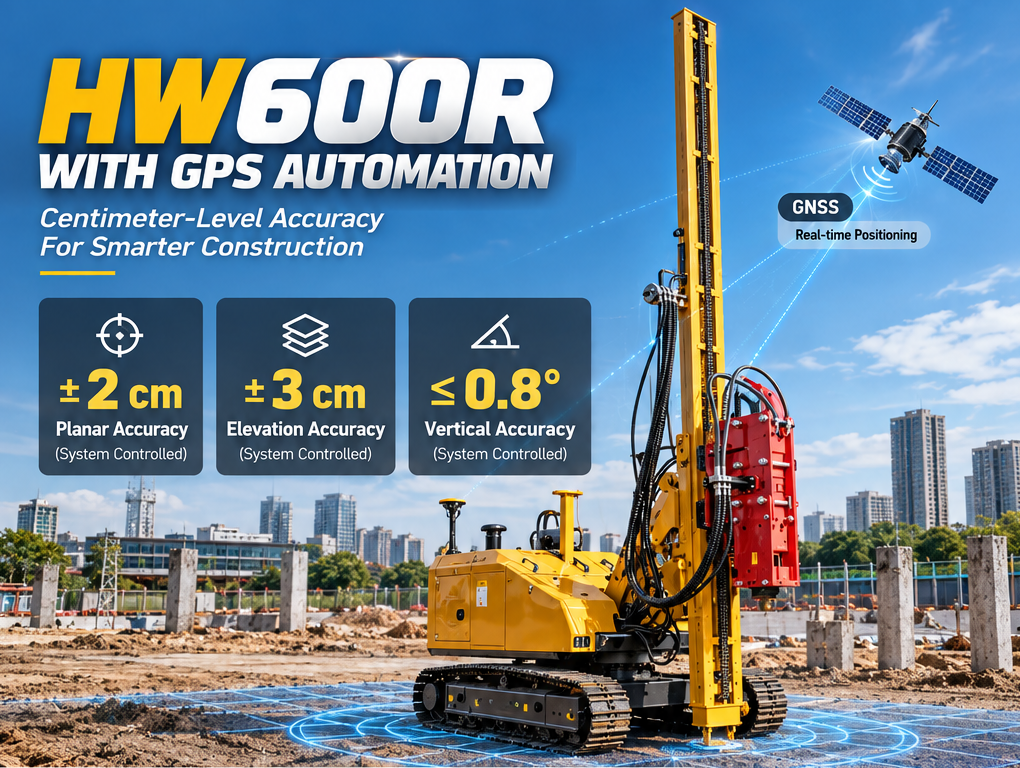
HW600R GPS Solar Pile Driver: Smart Positioning for More Efficient Solar Farm Construction As utility-scale solar projects continue to expand worldwide, solar construction contractors need equipment that delivers accurate pile positioning, consistent construction quality, and efficient on-site operation. The HW600R GPS solar pile driver is designed to support these requirements with intelligent positioning technology, autonomous path planning, remote operation, and radar-based obstacle avoidance. Equipped with a GPS-based positioning system, the HW600R helps automate key piling operations and reduce dependence on manual positioning. From importing project coordinates to moving between piling points, the machine is designed to make solar pile installation more systematic, precise, and manageable. For solar farm contractors, EPC companies, piling service providers, and construction equipment rental businesses, the HW600R offers a smarter approach to solar foundation construction.
1. GPS Positioning for Accurate Solar Pile Installation Accurate pile positioning is essential for solar mounting systems. Incorrect pile locations or deviations from the construction plan can complicate the installation of support structures and affect subsequent construction work. The HW600R integrates GPS positioning and system-controlled operation to support accurate piling point alignment. Key positioning specifications Planar positioning accuracy: ±2 cm Elevation accuracy: ±3 cm Verticality control: Within 0.8° These figures represent the stated system-controlled accuracy specifications. Actual results may depend on site conditions, positioning correction services, equipment calibration, and operating conditions. With coordinate-based positioning, the HW600R helps contractors reduce reliance on repeated manual measurements and improve consistency when working across large solar installation sites. Benefits for solar construction contractors Supports accurate pile positioning according to project coordinates. Reduces the need for repeated manual alignment. Helps maintain consistency across multiple piling points. Supports more organized construction workflows on large solar farms. For projects with extensive piling layouts, GPS-assisted positioning can help teams manage repetitive installation tasks more efficiently.
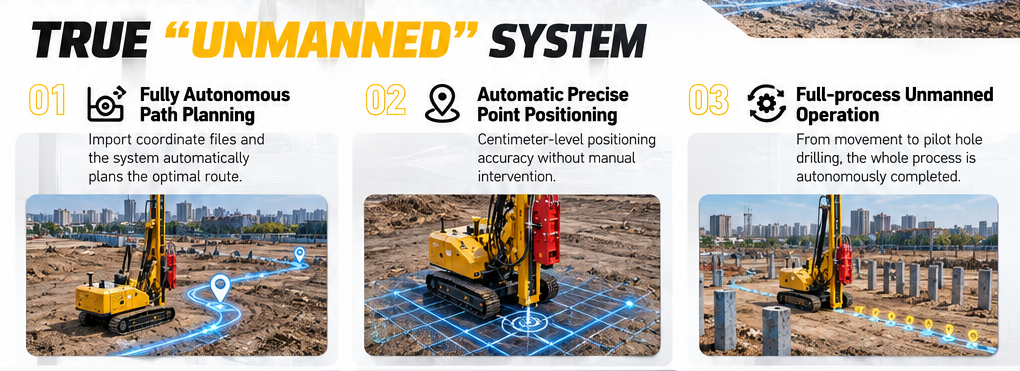
2. Autonomous Path Planning for Solar Farm Projects Large solar farms may require thousands of piles to be installed according to predefined coordinates. Moving between these points and maintaining an orderly construction sequence can take considerable time when managed entirely through manual operation. The HW600R supports autonomous path planning based on imported coordinate files. After the project coordinates are imported, the system can plan an optimized travel route for the machine. This helps organize movement between designated piling points and reduces the need for operators to direct every movement manually. Key capabilities include: Coordinate file import: Use project positioning data to define piling locations. Automatic route planning: Generate a suitable route between designated points. Automatic point positioning: Assist the machine in aligning with the target piling location. Automated operation: Support autonomous movement and pilot-hole drilling within the configured workflow. For EPC contractors and solar piling subcontractors, these functions can help standardize repetitive work and improve the management of large construction sites.
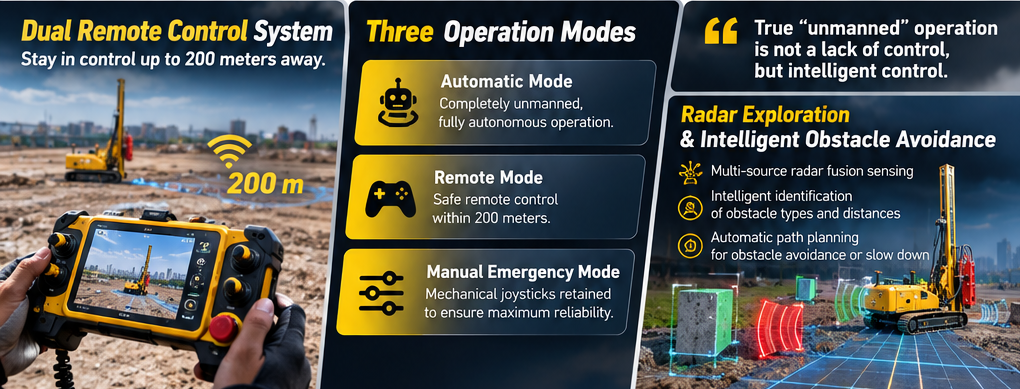
3. A Smarter Unmanned Solar Piling System The HW600R is designed to automate key stages of solar piling work, helping reduce the amount of continuous manual intervention required during routine operations. Its intelligent control system combines positioning, route planning, and automated operation to support a more coordinated workflow. Fully automatic mode In automatic mode, the system performs configured operations according to the project data and operating parameters. Once the required coordinates and working settings have been configured, the machine can carry out supported tasks with reduced manual intervention. Remote control mode The dual remote control system supports operation from up to 200 meters away under suitable operating conditions. This allows the operator to manage the machine from a more flexible position while maintaining oversight of the construction process. Emergency manual mode The HW600R retains mechanical joystick controls for emergency manual operation. This provides an alternative operating method when manual intervention is required. Intelligent automation does not mean the absence of control. It means using technology to make machine operation more precise, coordinated, and manageable. Actual operating procedures, safety distances, and the functions available in each mode should follow the manufacturer's instructions and the requirements of the construction site.
4. Radar-Based Intelligent Obstacle Avoidance Solar construction sites can contain temporary obstacles, construction materials, uneven ground, and other equipment. Safe machine movement requires operators to remain aware of surrounding conditions. The HW600R integrates multi-source radar sensing to support obstacle detection and intelligent avoidance. Its obstacle management functions are designed to: Detect obstacles and estimate their distance. Identify relevant obstacles using sensor information. Support automatic route adjustment where the system permits. Trigger deceleration or stopping responses when required by the configured control logic. By combining positioning information with radar-based sensing, the HW600R is designed to support more controlled movement around the worksite. Obstacle avoidance performance depends on sensor configuration, obstacle characteristics, environmental conditions, and system settings. Radar functions should supplement, rather than replace, appropriate site supervision and safety procedures.
5. Designed for Solar Farm Construction Efficiency Solar pile installation is a repetitive process in which positioning, machine movement, and consistent execution all matter. Improving individual steps can help contractors organize the overall workflow. The HW600R combines GPS positioning, automated path planning, remote operation, and intelligent obstacle sensing in one tracked machine. FeaturePotential construction benefitGPS positioningSupports accurate alignment with planned piling coordinatesAutomatic path planningHelps organize movement between piling pointsAutomatic operationReduces manual intervention in supported tasksRemote control up to 200 mOffers greater flexibility in operator positioningEmergency manual controlsRetains a manual operating optionRadar-based obstacle sensingSupports obstacle detection and controlled movement The overall productivity improvement will depend on pile specifications, soil conditions, site layout, operator training, machine configuration, and project requirements. Contractors should evaluate these factors when estimating installation capacity and project costs.
6. Who Should Consider the HW600R GPS Solar Pile Driver? The HW600R is designed for professional solar construction applications where positioning accuracy and automated operation are important. Solar EPC contractors For companies responsible for solar farm construction, GPS-assisted positioning and coordinate-based workflows can help organize piling operations across large project areas. Solar pile installation contractors Specialist piling teams can use automated positioning and remote operation to support repetitive installation work and improve workflow consistency. Solar project developers Developers evaluating construction equipment can consider the HW600R as part of a strategy to improve site coordination and construction process control. Construction equipment rental companies Rental businesses serving solar installation contractors may consider the machine for projects that require GPS positioning and intelligent operating functions. Before purchasing, buyers should confirm compatibility with their piling methods, pile dimensions, soil conditions, transport requirements, and project positioning data.
7. Why Choose a GPS-Equipped Solar Pile Driver? Traditional piling workflows may rely heavily on manual measurement, visual alignment, and operator-directed movement. GPS-assisted equipment introduces another approach by connecting project coordinates with machine positioning and automated movement. For suitable solar construction projects, this can help: Reduce repetitive manual positioning work. Improve consistency when aligning with planned pile locations. Organize machine movement between installation points. Support more flexible remote operation. Integrate positioning data into a more systematic construction workflow. The value of automation depends on how well the equipment matches the project. Buyers should assess not only the GPS system, but also the machine's piling performance, adaptability to site conditions, operating modes, service support, and overall ownership cost.
8. Request a Quote for the HW600R GPS Solar Pile Driver Looking for a GPS solar pile driver for your next photovoltaic project? The HW600R combines intelligent positioning, autonomous path planning, remote operation, and radar-based obstacle sensing to support modern solar pile installation. Contact Hengwang to discuss your project requirements and equipment configuration. To help us recommend a suitable solution, please provide: Project location and estimated installation area. Pile type, dimensions, and required installation depth. Soil conditions and terrain characteristics. Expected number of piles. Required positioning accuracy. Project schedule and equipment quantity. Our team can review your requirements and help you evaluate whether the HW600R is suitable for your solar construction project. Contact Hengwang today to request pricing, technical specifications, and configuration details for the HW600R GPS solar pile driver. Frequently Asked Questions
9. What is a GPS solar pile driver? A GPS solar pile driver is a piling machine equipped with satellite-based positioning technology to help align pile installation locations with project coordinates. Depending on its configuration, it may also support automated positioning, route planning, and other intelligent operating functions.
10. What is the positioning accuracy of the HW600R GPS solar pile driver? The stated system-controlled specifications are ±2 cm planar positioning accuracy and ±3 cm elevation accuracy, with verticality control within 0.8°. Actual performance depends on site conditions, system configuration, and positioning services.
11. Can the HW600R plan its own travel route? The HW600R supports autonomous path planning using imported coordinate files. The system can plan a route between designated piling points, subject to the configured workflow and site conditions.
12. Can the HW600R be operated remotely? Yes. The machine supports remote control from up to 200 meters away under suitable operating conditions. Operators must maintain appropriate site awareness and follow the manufacturer's safety instructions.
13. Does the HW600R support fully automatic operation? The HW600R provides an automatic operating mode for supported tasks, including configured movement and pilot-hole drilling workflows. The level of automation depends on the machine configuration, project data, and operating conditions.
14. Does the HW600R have obstacle avoidance? The machine integrates multi-source radar sensing designed to detect obstacles and support avoidance, deceleration, or stopping responses according to system settings. The system does not eliminate the need for site safety procedures.
15. How can I choose the right solar pile driver for my project? Consider pile dimensions, required installation depth, soil conditions, terrain, project coordinates, positioning requirements, daily production targets, and transport arrangements. Provide these details to the manufacturer for a more accurate equipment recommendation.
How can I get a quotation for the HW600R? Contact Hengwang with your project location, pile specifications, estimated quantity, and required delivery schedule. The sales team can review your requirements and provide relevant pricing and technical information.
Next: No data